


SUNfarming Lanka in the National Context
SUNfarming Lanka (Pvt) LTD a company of Sunfarming International GmbH, was founded in 2019 with the aim of implementing large-scale Agri-Solar projects on the island.
SF Lanka is strongly committed to the energy transition, environmental sustainability, and social responsibility. The company is represented by its CEO, Jayantha Jayamanna, who brings extensive experience in the renewable energy sector.
In 2021, solar photovoltaic generation in Sri Lanka still represented only a small share of total electricity production, with non-conventional renewable energy—including rooftop solar—accounting for around 5% of national electricity generation (Sri Lanka Energy Balance 2021, Ministry of Power and Energy).
Sri Lanka is also highly dependent on external energy sources: net energy imports represented approximately 60% of total energy use in 2022 (World Bank, World Development Indicators), highlighting the country’s structural reliance on the global energy market.
Electricity consumption per capita has shown a long-term upward trend, rising from roughly 510 kWh per person in 1990 to more than 6,100 kWh per person in 2022 (World Bank, World Development Indicators).
Given this combination of steadily increasing electricity demand and a high dependence on imported energy, renewable energy sources—such as solar—represent an increasingly valuable addition to Sri Lanka’s energy mix, offering both a clean generation and greater stability in the face of volatility in global energy markets.
Agri-Solar structures provide a significant added value, particularly on islands where both agricultural land and energy production capacity are limited. For certain types of crops or livestock production, the additional protection against heavy rainfall and sun damage offered by these systems, combined with the potential for technological enhancements—such as drip irrigation or cold storage facilities—represents a major advantage in areas where available land is scarce.
We are convinced that the future of the energy transition and agricultural production will involve minimizing the impacts and resources consumed, while generating a positive and lasting impact on local communities, and we are firmly committed to this path.

SUNfarming Food & Energy Research & Training Centre Ampitiya
Under the support from the German Energy Agency (dena), SUNfarming International GmbH plans to build its first SUNfarming Agri-Solar Food & Energy Training Centre in Sri Lanka in 2026.
This SUNfarming Agri-Solar plant will supply clean energy to the National Seminary of Our Lady of Lanka, located in Ampitiya, Kandy, in the Central Province, while also allowing crops to be grown beneath the panels with extra protection for plants and animals, and enabling the implementation of various technical training programs in photovoltaic technologies, and technified agriculture.
The Food & Energy Centre Ampitiya, with an installed power of 50.16 kWp will be a pilot system of the capabilities that the SUNfarming Agri- Solar concept can offer in Sri Lanka. The installation includes six Agri-Solar photovoltaic tables, with a minimum height of 2.1 m, adding 39.60 kWp of installed power. A photovoltaic training unit of 10.56 kWp is also included, designed specifically for educational use as a modular system, to facilitate the instruction of students in practical PV trainings.
SUNfarming perceives its Agri-Solar projects as a great opportunity to create jobs opportunities for the communities in agriculture, in addition to the jobs created by the construction and maintenance of the projects, and to support local communities through training in various technical areas such as agriculture, renewable energy, and electricity.
Our Agri-Solar systems use glass-glass bifacial transparent photovoltaic modules that allow a portion of sunlight to pass through, combined with structures featuring an innovative cascade design that protects crops in subequatorial climates, such as Sri Lanka’s, from heavy rainfall.
Thanks to the high flexibility of SUNfarming’s Agri-Solar concepts, local vegetables can be cultivated, and trials with various species and varieties can be carried out to identify those best suited to this climate.
The plants will benefit from this protection during both the rainy season—by shielding them from direct rainfall—and the dry season, through reduced soil evaporation and sunburn. These advantages are becoming increasingly important in the context of climate change and the rise in extreme weather events.
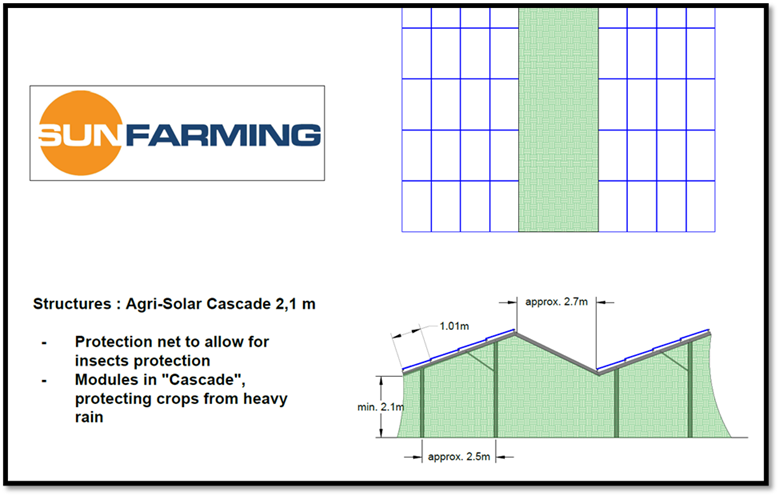
The previous illustration shows the selected system. After examining the climatic conditions and agricultural requirements for the region, it was decided to install a single type of structure (Agri-Solar) with modules in a cascade arrangement (protecting plants from heavy rainfall), whereby the system can be closed with protective nets, turning it into a real greenhouse.
The SUNfarming Agri-Solar Food & Energy facility in Ampitiya will serve not only as a portfolio and a stronghold for SUNfarming Sri Lanka, but also as a research and training center of reference in the agri-photovoltaic field, in collaboration with local educational and scientific institutions.
German Energy Agency (dena)
The German Energy Agency (dena) is a centre of excellence for the applied energy transition and climate protection. dena studies the challenges of building a climate-neutral society and supports the German government in achieving its energy and climate policy objectives. Since its foundation in 2000, dena has worked to develop and implement solutions and bring together national and international partners from politics, industry, the scientific community and all parts of society. dena is a project enterprise and a public company owned by the German federal government. dena’s shareholder is the Federal Republic of Germany. www.dena.de/en/
German Energy Solutions Initiative
With the aim of positioning German technologies and know-how worldwide, the German Energy Solutions Initiative of the Federal Ministry for Economic Affairs and Energy (BMWE) supports suppliers of climate-friendly energy solutions in opening up foreign markets. The focus lies on renewable energies, energy efficiency, smart grids and storage, as well as technologies such as power-to-gas and fuel cells. Aimed in particular at small and medium-sized enterprises, the German Energy Solutions Initiative supports participants through measures to prepare market entry as well as to prospect, develop and secure new markets. www.german-energy-solutions.de/GES/Navigation/EN/Home/home.html
Renewable Energy Solutions Programme (RES Programme)
With the RES Programme, the German Energy Solutions Initiative of the Federal Ministry for Economic Affairs and Energy (BMWE) helps German companies in the renewable energy and energy efficiency sectors enter new markets. Within the framework of the programme, reference plants are installed and marketed with the support of the German Energy Agency (dena). Information and training activities help ensure a sustainable market entry and demonstrate the quality of climate-friendly technologies made in Germany. www.german-energy-solutions.de/GES/Redaktion/EN/Basepages/Services/dena-res.html
This project is supported by the German Federal Ministry for Economic Affairs and Energy as part of the Renewable Energy as part of the Renewable Solutions Programme of the German Energy Solutions Initiative.